
By Ryan Windt | Head of Growth Marketing | Updated Septembert 2026
You bought a $1 million cyber insurance policy. You had a $400,000 ransomware incident. You filed a claim expecting full reimbursement.
Your insurer paid $250,000.
Nothing went wrong with your claim. You did not misrepresent anything on your application. Your policy did not have an exclusion that voided coverage. What you had was a sublimit, and you did not know it was there until it mattered.
This is one of the most common and most preventable coverage surprises in cyber insurance. Sublimits are standard policy mechanics, not fine print tricks. But they are routinely misunderstood, underexplained at the point of sale, and ignored until a claim forces the issue.
This post explains what sublimits are, which coverage lines are most commonly sublimited, and what to look for when you are reviewing or purchasing a policy.
What Is a Sublimit?
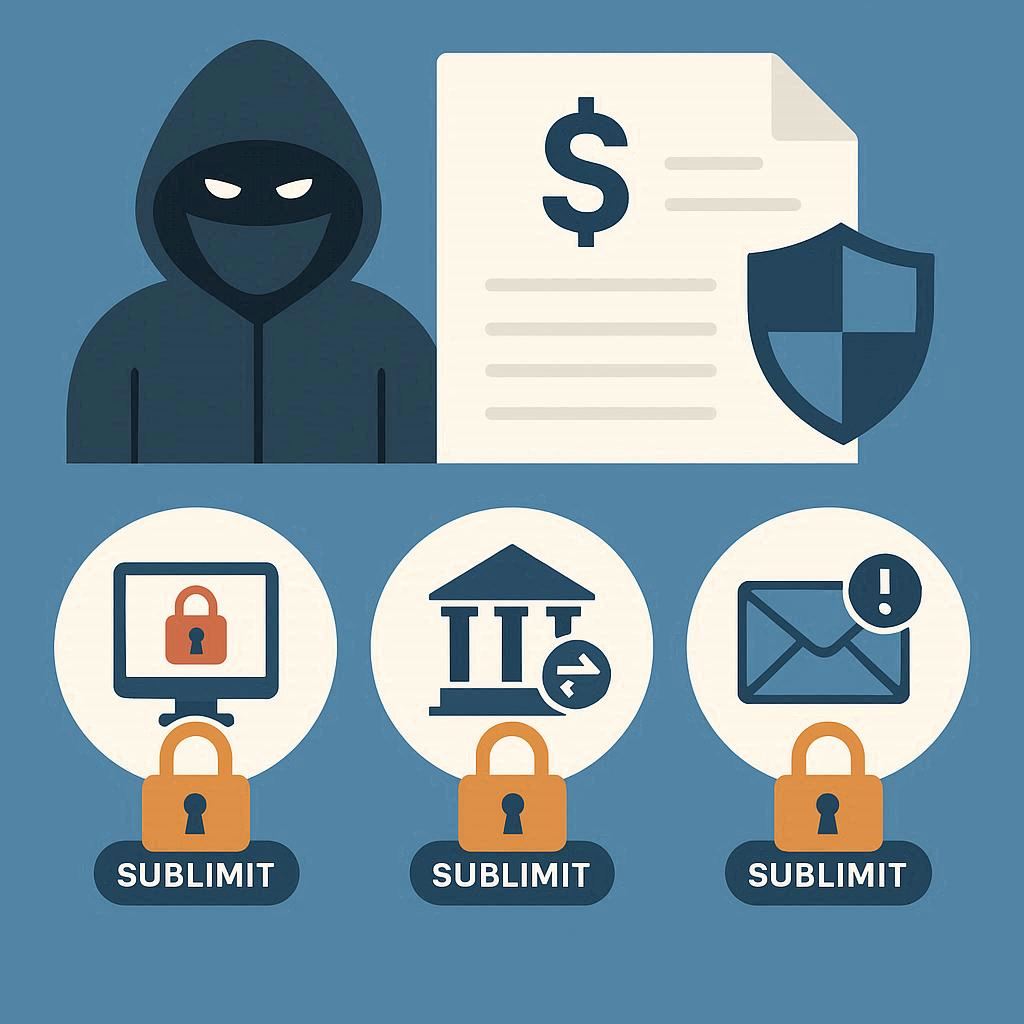
A sublimit is a cap on what your insurer will pay for a specific type of loss, set below the overall policy limit.
If your policy has a $1 million aggregate limit with a $250,000 sublimit on ransomware payments, your insurer will pay no more than $250,000 toward a ransom demand regardless of what your total policy limit says. The remaining $750,000 of aggregate limit is still available for other covered losses, but it cannot be redirected to cover the gap on the sublimited line.
Sublimits exist because certain loss categories carry concentrated risk that insurers price and manage separately from the overall policy. Ransomware payments, funds transfer fraud, and social engineering losses have each generated enormous aggregate claim volumes in recent years. Sublimits allow carriers to offer broad cyber policies at manageable premiums while controlling their exposure on the highest-frequency, highest-severity lines.
Understanding sublimits is not about finding a policy with none. It is about knowing exactly what limits apply to the losses your business is most likely to suffer.
The Coverage Lines Most Commonly Subject to Sublimits
Ransomware and Cyber Extortion
Ransomware sublimits are among the most consequential gaps in cyber insurance today. Average ransomware payments have climbed steadily, with demands routinely reaching six and seven figures for mid-market businesses. Many policies that were purchased when ransomware demands were lower now carry sublimits that no longer reflect current threat conditions.
A ransomware sublimit typically caps both the ransom payment itself and the negotiation costs associated with the event. Some policies apply the sublimit only to the ransom payment and cover forensic investigation and system restoration under separate, higher limits. Others apply a single sublimit to the entire ransomware event including remediation. The difference matters enormously when your systems are down and you are trying to understand what your policy will actually cover.
Key questions to ask:
- Does the ransomware sublimit apply only to the payment, or to the full event including restoration costs?
- Is there a separate sublimit on cyber extortion threats beyond file encryption, such as data publication threats?
- When was the sublimit last reviewed relative to current average ransom demands in your industry?
Funds Transfer Fraud
Funds transfer fraud coverage responds when a criminal tricks someone at your organization into wiring money to a fraudulent account. When the target is a business bank account rather than a single invoice, the question of who eats the loss gets more complicated, which we walk through in corporate account takeover. The attacker impersonates a vendor, an executive, or a client, the wire goes out, and the money is gone.
This is one of the most sublimited coverage lines in cyber insurance, and also one of the most frequently triggered. The FBI’s 2025 Internet Crime Report identified business email compromise as responsible for more than $2.7 billion in losses, making it the single highest-loss cybercrime category for the year.
Funds transfer fraud sublimits are often set significantly below the overall policy limit, sometimes as low as $100,000 or $250,000 on a $1 million policy. The reasoning from the carrier’s perspective is that social engineering losses, while financially severe, do not involve a technical compromise of your systems in the same way a network intrusion does. That distinction matters less to the business that just lost $350,000 to a fraudulent wire.
There is also an important coverage trigger question with funds transfer fraud. Some policies require that the fraudulent instruction be received through a compromised email account, meaning an attacker who actually accessed your email system. Others cover losses resulting from any deceptive communication, including spoofed emails that never touched your actual accounts. This distinction can determine whether a claim is covered at all, not just what the sublimit allows.
Key questions to ask:
- What is the sublimit on funds transfer fraud relative to the overall policy limit?
- Does coverage require a compromised account, or does it extend to spoofed communications?
- Is there a separate sublimit on social engineering losses, and how does it interact with the FTF sublimit?
Social Engineering and Business Email Compromise
Social engineering coverage is closely related to funds transfer fraud but is not always the same thing. Some policies treat them as a single coverage line. Others separate them, applying different sublimits and different trigger conditions to each.
Business email compromise, in which an attacker impersonates a trusted party to manipulate an employee into taking a harmful action, can result in fraudulent wire transfers, unauthorized data disclosure, fraudulent invoice payments, and gift card scams. Not all of those outcomes are covered under a funds transfer fraud sublimit. A policy that covers wire transfer losses but not fraudulent invoice payments or gift card fraud may leave gaps for the exact scenarios your employees are most likely to encounter.
Key questions to ask:
- Does the social engineering sublimit cover outcomes beyond wire transfers, including fraudulent invoices and gift card purchases?
- Is the social engineering sublimit separate from or combined with the funds transfer fraud sublimit?
- Are there any verification requirement conditions attached to the coverage, such as requiring a callback verification procedure?
Regulatory Fines and Penalties
When a data breach triggers a regulatory investigation, the resulting fines and penalties can be significant. HIPAA fines for healthcare organizations, state attorney general actions under consumer privacy laws, PCI DSS assessments for businesses that handle payment card data, and FTC enforcement actions all represent real financial exposure that businesses often assume their cyber policy fully covers.
The reality is more complicated. Regulatory fines and penalties are frequently sublimited, and in some jurisdictions certain fines are not insurable at all. A policy may include regulatory defense coverage, paying your legal costs during an investigation, while applying a much lower sublimit or outright exclusion to the fines themselves.
This gap is particularly significant for healthcare organizations operating under HIPAA, financial services firms subject to state and federal financial privacy regulations, and any business operating under a contract that requires PCI DSS compliance.
Key questions to ask:
- Does the policy cover regulatory fines and penalties, or only defense costs?
- What is the sublimit on regulatory fines, and does it vary by regulatory framework?
- Are there any jurisdictions or regulatory bodies explicitly excluded?
Business Interruption
Business interruption is now the largest driver of cyber insurance claims. Extended outages cost businesses not just in lost revenue but in emergency labor, temporary workarounds, expedited vendor costs, and client relationship damage.
Most cyber policies include business interruption coverage, but many apply sublimits or waiting periods that reduce what is actually paid. A policy with a 12-hour waiting period, sometimes called a retention period or time deductible, will not pay for the first 12 hours of an outage. For a business that loses $20,000 per hour during a disruption, that retention can represent a significant self-insured cost before coverage even begins.
Dependent business interruption, which covers losses caused by an outage at a vendor or cloud provider your business relies on, is often sublimited separately from direct business interruption. If your operations depend on a third-party platform and that platform goes down, your policy may cover far less of the resulting loss than you expect.
Key questions to ask:
- What is the waiting period before business interruption coverage begins?
- Is there a sublimit on business interruption that is lower than the overall policy limit?
- Does the policy include dependent business interruption, and what is that sublimit?
- How is the loss calculation methodology defined in the policy?
Breach Notification and Credit Monitoring
Breach notification costs are sometimes perceived as the core of what cyber insurance covers, but they are also commonly sublimited, particularly on older or lower-premium policies. Notifying thousands of affected individuals, standing up a call center, and providing credit monitoring services for one to two years can cost far more than businesses anticipate.
For high-volume data handlers, healthcare organizations, retailers, and financial services firms, breach notification costs alone can exceed a sublimit that looked adequate when the policy was purchased.
Key questions to ask:
- Is there a separate sublimit on breach notification and credit monitoring, or do these costs draw against the overall policy limit?
- Does the policy cap the number of individuals it will notify, or the duration of credit monitoring it will fund?
- Given your actual record count, would the sublimit cover a full notification event, or only a fraction of your affected population?
Hardware Replacement and Bricking
When a cyberattack corrupts a device’s firmware badly enough that the hardware is permanently unusable, replacing it is a real cost that standard property insurance often will not cover, because nothing physically happened to the device. Cyber policies increasingly address this through bricking, or hardware replacement, coverage, but it is one of the most heavily sublimited lines on the policy. A business with a large or specialized device fleet can find that the bricking sublimit, or a per-device cap, covers only a fraction of the true replacement bill. For the full picture of how this coverage works and what to check, see Bricking Coverage in Cyber Insurance.
Key questions to ask:
- Is bricking or hardware replacement coverage included, or only available as an endorsement?
- What is the sublimit, and is there a separate per-device cap that could limit a large-fleet replacement?
- Does coverage respond to a single bricked device, or only to mass bricking events?
How Sublimits Stack: A Realistic Claim Scenario
Consider a mid-sized professional services firm with a $1 million cyber policy. They are hit with a business email compromise event that results in a $300,000 fraudulent wire transfer. The investigation reveals that the attacker accessed their email environment for several weeks before initiating the fraud. During the forensic response, systems are taken offline for four days, resulting in $180,000 in business interruption loss. Notification costs for the exposed client data run $85,000.
Here is how sublimits might interact with that scenario:
| Loss Type | Actual Loss | Policy Sublimit | Covered |
|---|---|---|---|
| Funds transfer fraud | $300,000 | $150,000 | $150,000 |
| Business interruption | $180,000 | $250,000 | $180,000 |
| Breach notification | $85,000 | $100,000 | $85,000 |
| Forensic investigation | $45,000 | No sublimit | $45,000 |
| Total | $610,000 | $460,000 |
The firm had a $1 million policy and suffered $610,000 in losses. They received $460,000 in coverage. The $150,000 gap is entirely attributable to the funds transfer fraud sublimit. Nothing about this outcome required fraud, bad faith, or an exclusion. The sublimit did exactly what it was designed to do.
What to Do Before You Buy or Renew
Sublimits are not inherently bad. They are a normal part of how cyber policies are structured. The problem is buying a policy without understanding which lines are sublimited and whether those sublimits are adequate for your actual risk exposure.
Before you finalize a purchase or sign a renewal, ask your underwriter or broker to walk through every sublimit in the policy, not just the aggregate limit. Specifically:
Map sublimits to your actual exposure. If your business processes large wire transfers, the funds transfer fraud sublimit is the most important number in your policy. If you store large volumes of personal health information, breach notification costs and regulatory fines are where you need to pay attention. Match your review to your actual risk profile.
Compare sublimits to current loss data. Average ransomware demands, average BEC losses, and average loss figures shift year over year. A sublimit that was adequate at your last renewal may no longer reflect what a realistic loss looks like in your industry today.
Understand what triggers each sublimited coverage line. Coverage trigger conditions matter as much as the dollar limit. A funds transfer fraud sublimit that only responds to losses through compromised accounts is a narrower protection than one that covers all deceptive communications.
Ask about the cost to increase sublimits. In many cases, sublimits can be increased for a relatively modest additional premium. That conversation is worth having before a claim, not after.
The Relationship Between Sublimits and Claim Denials
Sublimits and claim denials are different problems, but they are often confused. A sublimit does not deny your claim. It limits how much your insurer pays on a covered loss. A denial means the loss is not covered at all.
That said, the practical outcome can feel similar when a sublimit leaves you with a significant uninsured gap. And in some cases, sublimit confusion compounds a denial: a business that misunderstands its funds transfer fraud sublimit may file a claim expecting full reimbursement, receive a partial payment, and incorrectly conclude that the claim was improperly handled.
Understanding your sublimits in advance is the clearest way to avoid that confusion. It also puts you in a position to make informed decisions about whether to increase specific limits, purchase excess coverage, or accept the gap as a self-insured retention.
For more on how application accuracy affects claim outcomes, see: How to Fill Out a Cyber Insurance Application Without Getting Your Claim Denied
For context on the two types of losses that sublimits most commonly affect, see: First-Party vs. Third-Party Cyber Insurance: What Every Business Needs to Know
When a Sublimit Is Challenged: A 2026 Ruling Worth Knowing
Sublimits are usually enforced exactly as written, which is why the wording matters so much. A recent federal case shows what happens when that wording is not clear.
In CiCi Enterprises v. HSB Specialty Insurance Company, decided in the Northern District of Texas in February 2026, a restaurant franchise was hit by ransomware and ran up roughly $1.2 million in costs, including a $400,000 ransom payment. The insurer agreed the loss triggered several coverages, including cyber extortion, under a policy with a $3 million aggregate limit. It then pointed to a ransomware sub-limit endorsement, paid $250,000, and treated that as the ceiling.
The court disagreed. It found the endorsement never said which coverages it actually limited. The endorsement sat in the limits section of the policy rather than the section that grants coverage, and unlike other endorsements in the same policy, it did not name cyber extortion anywhere. Because the insurer had not clearly tied the $250,000 cap to the cyber extortion coverage, the court held the cap did not apply to it, and the full limit remained in play. For a closer look, see how courts have ruled on sublimit disputes.
Two things are worth keeping in perspective. This is a trial-court ruling in a case that is not over, and the policyholder’s bad-faith claims are still headed to trial. And the lesson runs in both directions. The outcome turned entirely on how the endorsement was drafted, not on any general rule that courts will override sublimits when a policyholder does not like them.
The practical takeaway is not that sublimits fail. It is that whether a sublimit applies comes down to the exact words, and neither you nor your insurer can assume how yours behaves without reading the endorsement against the coverage it is supposed to modify.
If you are not certain how the sublimits in your policy interact with each coverage, that is worth resolving before a claim rather than during one.
The Bottom Line
Your cyber insurance policy limit is a ceiling, not a guarantee. The number that determines what you actually collect on any specific type of loss is the sublimit that applies to that coverage line.
The businesses that get surprised by sublimits at claim time are almost always the ones that reviewed the aggregate limit and stopped there. A five-minute conversation about sublimits before you bind coverage can change the outcome of a claim by six figures.
Ask the question before you need the answer.
Want to review your sublimits with an underwriter who will actually explain them? SeedPod Cyber works directly with businesses, MSPs, and brokers to build cyber insurance programs where you understand exactly what you are buying. Contact our team or get a quote.