
By Ryan Windt | Head of Growth Marketing | Updated September 2026
Property management companies don’t think of themselves as high-value cyber targets. They’re not banks. They’re not hospitals. But they process rent payments, store tenant Social Security numbers and bank account details, manage maintenance vendor relationships, and in many cases handle HOA reserve funds and association financials. That combination of personal data, financial transaction volume, and operational dependency on third-party portals makes property management a more attractive target than most owners and operators realize.
This post covers the specific risks facing property management companies, what cyber insurance covers, what underwriters are looking for, and how to think about building the right program.
Why Property Management Is a Cyber Target
The risk profile for property management comes from a few converging factors.
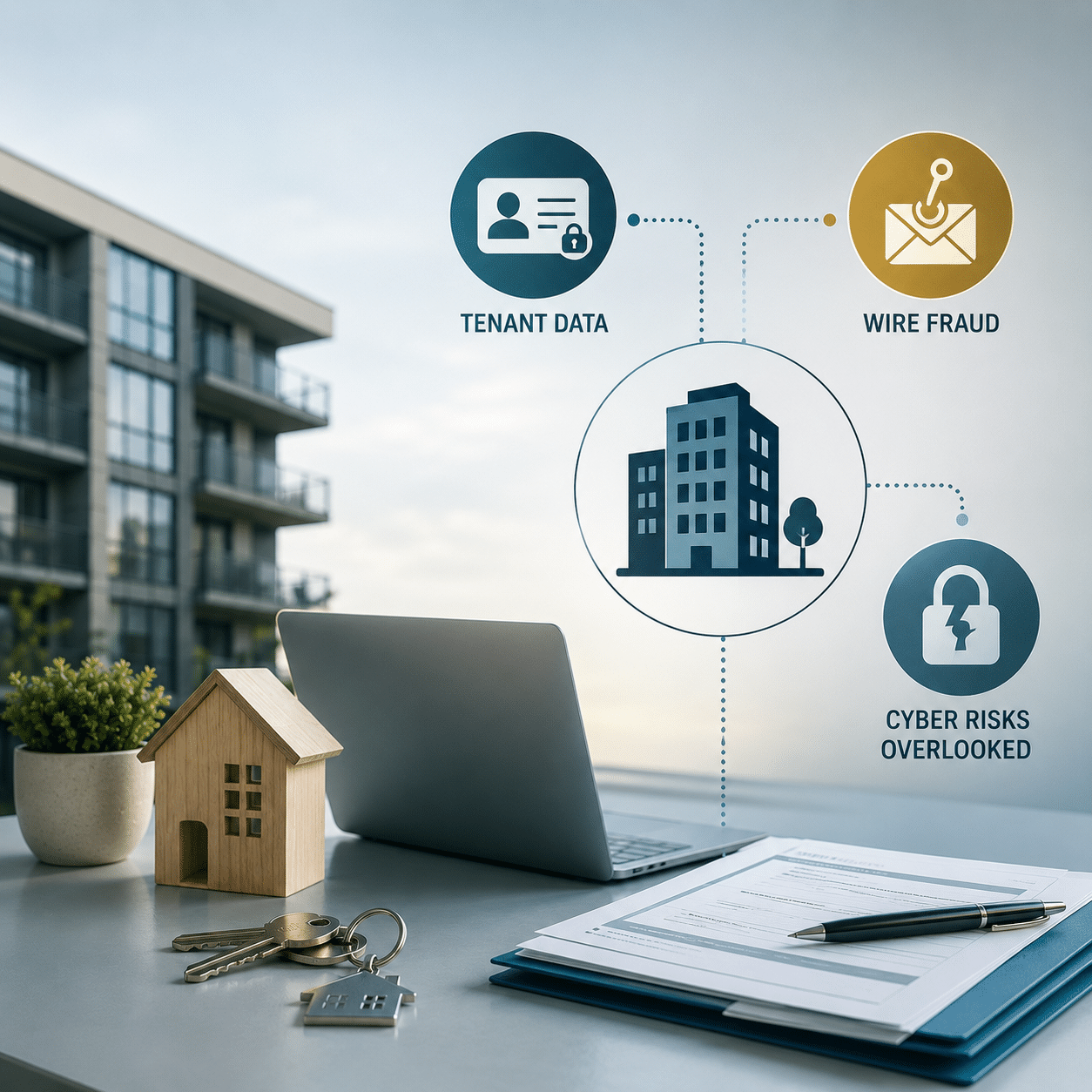
Tenant data volume. A mid-size property management company managing several hundred residential units holds a substantial amount of sensitive personal information. Rental applications require Social Security numbers, employment history, and bank account details for background checks and ACH setup. That data lives in property management software, leasing platforms, and email inboxes. A breach exposing tenant PII triggers data breach notification obligations under state law, credit monitoring costs, and potential regulatory scrutiny.
Wire transfer fraud. Property management involves regular high-value wire transfers: security deposits, owner distributions, HOA reserve transfers, vendor payments, and lease transactions. Business email compromise targeting these workflows is one of the most common cyber claims in the industry. A fraudulent email impersonating an owner, vendor, or title company requesting a change to wire instructions can result in significant losses before the fraud is detected.
HOA and association funds. Companies managing homeowners associations or condominium associations handle reserve funds that can run into the hundreds of thousands or millions of dollars. Fraudulent transfers from these accounts create both financial and fiduciary liability exposure.
Vendor and software dependencies. Property managers rely heavily on third-party platforms for leasing, maintenance, payments, and tenant communications. A breach at one of these vendors can expose tenant data or disrupt operations even when the property management company’s own security posture is reasonable. Most property management software platforms have been targeted at various points, and the credential exposure from those incidents affects downstream customers.
Ransomware disruption. A ransomware attack that encrypts access to property management software, tenant records, or financial systems can halt rent collection, maintenance coordination, and owner reporting. The business interruption exposure during recovery is a real financial risk.
What Cyber Insurance Covers for Property Management Companies
A well-structured cyber policy addresses the primary risk areas facing property managers across both first-party costs and third-party liability.
Data breach response costs. When tenant PII is exposed, the policy covers the costs of forensic investigation to determine what was accessed, legal counsel to navigate notification obligations, notification to affected tenants, and credit monitoring services. These costs add up quickly even in relatively contained incidents.
Funds transfer fraud. Social engineering coverage and funds transfer fraud coverage within a cyber policy can respond when a fraudulent wire instruction results in a misdirected payment. Coverage terms vary by carrier and policy, so the limits and conditions matter. Some policies require that specific internal verification controls were followed for coverage to apply.
Business interruption. If a ransomware attack or system outage disrupts your ability to collect rent, access tenant records, or operate your management platform, business interruption coverage compensates for lost income and extra expenses during the restoration period.
Ransomware and extortion. Cyber extortion coverage pays ransom demands and the associated costs of negotiation and response when threat actors encrypt your systems or threaten to publish tenant data.
Third-party liability. If a breach of your systems results in harm to tenants, property owners, or HOA members, third-party liability coverage responds to claims and litigation. This includes claims arising from failure to safeguard personal information.
Regulatory defense and fines. State data breach notification laws create regulatory exposure. If a state attorney general investigates your response to a breach, coverage for regulatory defense costs and, where insurable, fines and penalties is available in many cyber policies.
Coverage Gaps to Watch For
Not every loss scenario is automatically covered. A few areas where property management companies encounter gaps:
Funds transfer fraud sublimits. Many policies carry sublimits on social engineering and funds transfer fraud that are substantially lower than the overall policy limit. A policy with a $1 million limit may have a $100,000 sublimit on wire fraud. Given the transaction sizes involved in property management, verify that this sublimit is adequate.
Vendor-caused breaches. If a third-party platform breach exposes your tenant data, coverage under your own cyber policy may be limited or contested. Some policies exclude losses arising from a vendor’s failure. Understanding how your policy handles third-party-caused events is important given the software dependency in property management.
HOA funds. Whether losses from fraudulent transfers out of HOA reserve accounts are covered under a cyber policy, a crime policy, or a fidelity bond depends on how the loss occurred and how the policy is structured. This is an area worth specific attention when placing coverage for companies managing associations.
Property damage from cyber events. If a cyber incident affecting building systems like HVAC, access controls, or elevators causes physical damage or injury, standard cyber policies typically exclude bodily injury and property damage. This exposure may need to be addressed through other coverage lines.
What Underwriters Are Looking For
Property management companies face a fairly standard underwriting review, but a few areas get specific attention given the industry’s risk profile.
Funds transfer verification controls. Because wire fraud is a primary risk, underwriters want to know whether you have a call-back verification process for wire instruction changes. The expectation is that any request to change payment instructions triggers a verification call to a known number before the change is processed. Companies without this control are seen as higher risk for social engineering losses.
Access controls for financial systems. Who has the ability to initiate and approve wire transfers? Dual-control requirements, meaning a separate approver for any outgoing wire, are viewed favorably. Shared credentials or single-person authorization for large transfers are underwriting concerns.
Multi-factor authentication. MFA on email, financial platforms, and property management software is a baseline expectation at most carriers. MFA on email in particular is important because BEC attacks typically start with email account compromise.
Data handling practices. How tenant PII is stored, who has access to it, and whether it’s retained longer than necessary are relevant questions. Underwriters are looking for basic data hygiene: limited access, defined retention policies, and encryption of stored sensitive data.
Patch management. As with most businesses, keeping systems and software current is a basic underwriting expectation. Property management software platforms release security updates, and staying current is part of the expected security baseline.
Property Management Subsectors and Nuances
The property management industry covers a range of business models, and the risk profile varies somewhat across them.
Residential property management. The primary exposure is tenant PII and rent payment fraud. The volume of sensitive personal data from rental applications drives the data breach risk.
Commercial property management. Tenant profiles shift to businesses rather than individuals, but the data exposure remains significant. Commercial leases involve detailed financial information, and vendor relationships are more complex.
HOA and community association management. The reserve fund exposure adds a layer of financial risk beyond what most residential or commercial managers face. Association management companies handling large reserve accounts should pay particular attention to funds transfer fraud coverage and fidelity bond coordination.
Short-term rental management. Companies managing Airbnb-style or vacation rental portfolios have additional exposure through guest payment data, platform integrations, and the reputational risk of guest data exposure.
Real estate firms with in-house management. If a real estate brokerage or investment firm manages properties internally, the cyber exposure may be bundled into a broader coverage program. Verify that the policy adequately addresses the property management operations specifically, since underwriting for a brokerage and a management company can differ.
How Cyber Insurance Relates to Other Coverage
Cyber insurance doesn’t operate in isolation for property management companies. A few coverage coordination points worth understanding:
Crime and fidelity coverage. Employee theft, forgery, and some forms of funds transfer fraud may fall under a commercial crime policy or fidelity bond rather than cyber. The line between a cyber-enabled theft and a straight crime loss isn’t always clean. Understanding how these policies coordinate, and whether there are gaps or overlaps, is part of structuring the right program.
Professional liability / E&O. If a property management error or omission results in a client loss, professional liability coverage responds. A cyber incident that causes you to miss a lease renewal deadline or fail to properly maintain tenant records could implicate professional liability as well as cyber. These coverages interact, and having both in place matters.
General liability. GL policies typically exclude cyber-related losses, and the gap between GL and cyber is real for property managers. If a tenant claims harm from a data breach, GL is unlikely to respond.
Frequently Asked Questions
Does cyber insurance cover wire fraud if an employee was tricked into sending the payment?
It can, but the coverage terms matter significantly. Social engineering and funds transfer fraud coverage is typically subject to a sublimit and may require that specific verification procedures were followed. If your policy requires a call-back verification for wire instruction changes and that step wasn’t taken, coverage may be reduced or denied. Review your policy’s conditions carefully and make sure your procedures align with them.
Are HOA reserve funds covered if they’re fraudulently transferred?
This depends on the structure of the loss and how the policy is written. A cyber policy may cover the loss if it resulted from a cyber event like a hacked email account. A crime or fidelity policy may respond if the mechanism was employee dishonesty or forgery. Many HOA management companies need both coverages to address the full range of scenarios. This is an area where working with a broker who understands the specific exposure matters.
Do I need cyber insurance if my property management software vendor handles data security?
Yes. Your vendor’s security practices reduce your risk but don’t eliminate your liability. If a breach occurs through your vendor and tenant data is exposed, notification obligations and potential claims run to you as the data controller, not just the vendor. Your vendor’s cyber insurance, if they have it, protects them. Your policy protects you.
What does cyber insurance cost for a property management company?
Premiums vary based on revenue, number of units managed, security controls in place, and prior loss history. Small to mid-size property management companies typically see premiums in the range of a few thousand dollars annually for reasonable limits. Companies managing large HOA reserve balances or with significant wire transfer volume may pay more given the elevated funds transfer fraud exposure. Getting quotes from multiple carriers through a broker is the best way to understand your specific market.
How much cyber insurance does a property management company need?
Coverage limits should reflect your realistic loss scenarios. For a residential property manager, consider the cost of notifying all current and recent tenants in a worst-case breach, plus business interruption costs during a ransomware recovery. For companies managing association funds, the size of the largest reserve account under management is relevant to sizing wire fraud sublimits. A broker can help you model these scenarios against available limits.
Related Resources
- Cyber Insurance Requirements by Industry
- Cyber Insurance for Real Estate Firms: What You Need, What It Costs, and What Underwriters Are Looking For
- Business Email Compromise: What Cyber Insurance Covers, What It Doesn’t, and Where the Gaps Are
- Social Engineering and Funds Transfer Fraud Coverage: What Cyber Insurance Pays and What It Doesn’t
- Cyber Insurance Requirements: What Underwriters Actually Check
- Cyber Insurance Underwriting: What Carriers Evaluate and How to Prepare Your Application
- What Small Businesses Actually Need from Cyber Insurance and What Most Policies Miss
Property management companies sit at the intersection of personal data, financial transactions, and fiduciary responsibility in ways that create real cyber exposure. The risks are specific enough that a generic small business policy often leaves meaningful gaps. A broker who understands the industry can help you build coverage that actually fits.
Ready to get started? Contact us or explore your coverage options.