
By Ryan Windt | Head of Growth Marketing | Updated September 2026
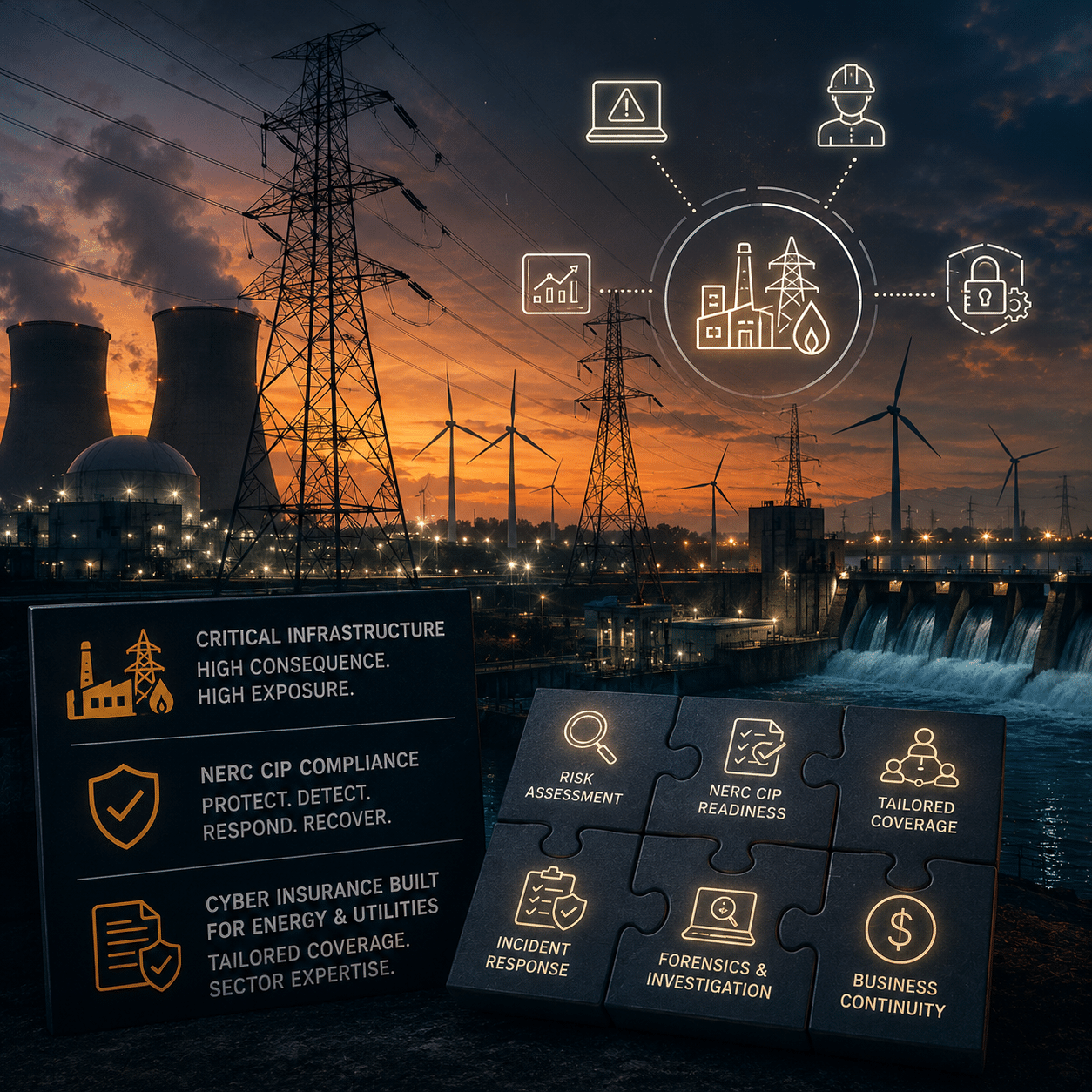
Energy and utility companies operate at the intersection of two things that make cyber risk uniquely consequential: critical infrastructure that cannot tolerate extended downtime, and regulatory frameworks that create enforcement exposure layered on top of any incident response cost. For related guidance, see cyber coverage built for local government.
A ransomware attack on a regional electric cooperative is not just an IT problem. It is a potential public safety event, a NERC CIP compliance matter, a state public utility commission issue, and a reputational crisis, all running simultaneously. The financial exposure from a single significant incident can dwarf the cost of the incident response itself when regulatory fines, business interruption, and third-party liability are added together.
This guide covers what electric utilities, power generation companies, water and wastewater systems, natural gas operators, oil and gas companies, and renewable energy developers need to understand about cyber liability insurance: what the coverage gaps look like, how underwriters evaluate this sector, and how to build a program that holds up when something goes wrong.
The Threat Landscape for Energy and Utilities
The energy sector is one of the most targeted industries for cyberattacks globally, and the targeting is not random. The exposure spans the full sector: power generation, transmission and distribution utilities, water and wastewater systems, oil and gas, and a fast-growing base of renewable energy operators. Nation-state actors with geopolitical objectives, ransomware groups seeking maximum leverage, and hacktivists pursuing political agendas all target energy infrastructure specifically because of its systemic importance.
The Colonial Pipeline attack in 2021 demonstrated that a ransomware attack on energy infrastructure could trigger fuel shortages across a multistate region within days. Attacks on Ukrainian power infrastructure have shown that grid disruption is a viable military and political weapon. CISA and the FBI issue regular advisories specifically naming energy sector organizations as active targets for a range of threat actors.
What makes the energy sector particularly difficult to defend is the combination of legacy operational technology, IT/OT convergence that has expanded the attack surface, and the operational constraints that limit the security controls that can be applied to systems managing physical infrastructure. Many of the security practices that are standard in IT environments, including aggressive patching, endpoint detection tools, and network monitoring, are significantly more complicated to implement in OT environments without creating operational risk.
Regulatory Frameworks That Shape the Coverage Conversation
NERC CIP
Electric utilities subject to NERC Critical Infrastructure Protection standards operate under one of the most prescriptive cybersecurity regulatory frameworks in any industry. NERC CIP requirements cover electronic security perimeters, access management, incident reporting, recovery planning, and supply chain risk management, among other areas. Violations can result in civil monetary penalties that are among the highest in the utility regulatory space.
Cyber insurance with regulatory defense and fines coverage applies to NERC CIP enforcement actions, subject to policy conditions and the insurability of penalties in the applicable jurisdiction. The more important coverage question for NERC-regulated utilities is whether their policy’s incident response obligations, including the carrier’s notification and reporting requirements, are compatible with NERC CIP’s own incident reporting timeline requirements. Conflicts between policy conditions and regulatory obligations need to be identified before an incident, not during one.
AWIA and Water Sector Requirements
The America’s Water Infrastructure Act created cybersecurity assessment and emergency response planning requirements for community water systems above certain size thresholds. Water and wastewater utilities face a regulatory framework that is less prescriptive than NERC CIP but is evolving, with EPA guidance and state-level requirements adding layers of obligation that affect both security posture and insurance program design.
TSA Pipeline Security Directives
Following the Colonial Pipeline attack, the Transportation Security Administration issued security directives imposing specific cybersecurity requirements on critical pipeline operators, including incident reporting within 12 hours of discovery, network segmentation requirements, and access control mandates. Pipeline operators subject to TSA directives have regulatory compliance obligations that directly intersect with cyber insurance underwriting requirements.
State Public Utility Commission Requirements
State PUCs regulate investor-owned utilities in most states and have authority over cybersecurity practices, incident disclosure, and cost recovery. The ability to recover cybersecurity investment and incident response costs through rate cases varies by state and is an important financial planning consideration for regulated utilities that is distinct from the insurance question but related to it.
Coverage Gaps That Matter Most in Energy and Utilities
The Physical Damage Problem
An attack that causes physical damage to energy infrastructure, whether through manipulation of control systems, destruction of equipment, or cascading failures triggered by a cyber event, creates a loss that sits at the boundary between cyber insurance and property insurance. Standard cyber policies cover data loss, system restoration, and business interruption. Physical damage to transformers, turbines, pumps, or pipeline infrastructure is typically a property insurance matter.
The complication is that many property policies now exclude losses caused by cyberattacks. The resulting gap, where neither the cyber policy nor the property policy clearly responds to cyber-caused physical damage, is a documented coverage problem in the energy sector. Addressing it requires explicit coordination between your cyber and property programs and, in many cases, specific endorsements on one or both policies. For a full explanation of how silent cyber creates this gap, see our post on silent cyber and what it means for your policies.
Business Interruption for Extended Outages
Standard cyber business interruption coverage is designed around IT recovery timelines measured in days or weeks. Energy infrastructure outages can run significantly longer when physical damage is involved, when regulatory requalification is required before systems can return to service, or when specialized replacement equipment has extended lead times. A substation transformer with a 12-month replacement lead time creates a business interruption exposure that no standard cyber BI calculation was designed to cover.
Modeling the actual business interruption exposure from a worst-case OT incident, including physical damage scenarios and regulatory hold periods, is essential for sizing coverage limits appropriately. For a framework on how to approach limit selection, see our post on how much cyber insurance you need.
Nation-State and War Exclusions
Energy infrastructure is a documented target for nation-state cyber operations, and most cyber policies now include exclusions for losses caused by nation-state attacks or acts of war. The Lloyd’s of London market has issued specific guidance requiring affiliated syndicates to include nation-state exclusions in their cyber policy forms. For energy companies that face a credible nation-state threat, understanding exactly what these exclusions cover, and what coverage remains after they apply, is a material underwriting question. For more on how these exclusions work, see our posts on nation-state exclusions in cyber insurance and geopolitical risk and cyber insurance.
Supply Chain and Vendor Risk
Energy infrastructure depends on a complex supply chain of equipment vendors, software providers, system integrators, and managed service providers. A compromise of a vendor with access to energy control systems can provide an attacker with a path into infrastructure that is otherwise well-defended. The SolarWinds and Kaseya attacks demonstrated how supply chain compromises can propagate broadly through organizations that share a common vendor. For more on how supply chain coverage works, see our post on supply chain attacks and cyber insurance.
What Underwriters Evaluate in Energy and Utility Accounts
Energy and utility underwriting has become a specialized discipline within the cyber insurance market. Carriers with meaningful appetite in this sector apply a more intensive evaluation process than they use for commercial accounts of comparable revenue. Here is what they are looking at.
IT/OT Network Architecture
The primary underwriting question for any energy company with OT systems is how IT and OT networks are separated and what controls exist at the boundary. Flat networks where corporate IT and industrial control systems share connectivity are a significant concern. Documented segmentation architecture, unidirectional gateways, and DMZ designs between IT and OT environments are positive underwriting factors that can meaningfully affect both the availability of coverage and its price.
NERC CIP Compliance Status
For electric utilities subject to NERC CIP, compliance status is a direct underwriting input. Utilities in good standing with their regional reliability organization, without recent significant violations, are viewed more favorably than those with open enforcement actions or documented compliance gaps. NERC CIP compliance demonstrates that the organization has met a prescriptive external standard for security controls, which reduces the underwriter’s need to assess those controls independently.
Incident Response and Recovery Planning
Underwriters want to see documented incident response plans that address OT scenarios specifically, not just IT scenarios. For energy companies, that means the IR plan should address how decisions are made about taking systems offline, how manual operations are managed during a cyber event, how regulatory notification obligations are met within required timeframes, and how restoration is prioritized across critical versus non-critical systems.
Vendor and Third-Party Access Controls
How vendor remote access to OT systems is managed is an active underwriting question. Jump servers, privileged access management tools, time-limited access credentials, and monitoring of vendor sessions are controls that underwriters look for in energy accounts. Uncontrolled or unmonitored vendor access to industrial control systems is a documented risk factor that affects underwriting terms.
Backup Architecture for OT Environments
Configuration backups for industrial control systems, historian data backups, and engineering workstation backups are all relevant for recovery from a significant OT incident. The backup question for energy companies goes beyond whether backups exist to whether they are maintained at a cadence that allows meaningful recovery, whether they are isolated from the production environment, and whether restoration has been tested. For more on backup requirements in cyber underwriting, see our post on immutable backups and cyber insurance.
How the Insurance Market Is Structured for Energy
The cyber liability insurance market for large energy companies operates differently from the standard commercial cyber market. Accounts above a certain revenue threshold or with complex OT environments are placed through manuscript policy negotiations rather than standard forms, often involving multiple carriers sharing layers of the risk. The market capacity available for large energy accounts has fluctuated significantly as carriers have reassessed their appetite following high-profile energy sector incidents.
For mid-market energy companies, including regional electric cooperatives, municipal utilities, midsize pipeline operators, and independent power producers, the standard commercial cyber market is accessible but requires underwriting expertise specific to energy accounts, whether accessed through a specialist provider or an experienced broker. The underwriting questions are more technical than those for a commercial account of comparable revenue, and the coverage design considerations around OT, physical damage, and regulatory compliance require specific expertise to address correctly.
Renewable energy developers and operators, including wind, solar, and battery storage facilities, face a cyber risk profile that is increasingly relevant as these assets become more connected and more targeted. The underwriting market for renewable energy cyber is less mature than for conventional power generation, which creates both opportunity and uncertainty in coverage terms.
Frequently Asked Questions
Does cyber insurance cover a ransomware attack that shuts down energy operations?
Yes, subject to policy conditions and sublimits. Ransomware coverage pays extortion demands and system restoration costs. Business interruption coverage pays for lost revenue and extra expenses during the period of restoration. The key questions for energy operators are whether the sublimits on these coverage components are adequate relative to the actual exposure, and whether the BI coverage addresses OT recovery timelines rather than standard IT recovery assumptions. For more detail, see our post on what ransomware insurance actually covers.
Are NERC CIP fines covered by cyber insurance?
Regulatory defense costs and, where insurable by law, civil monetary penalties are covered under the regulatory fines coverage component of most cyber policies. NERC CIP civil monetary penalties are generally insurable, though the specific policy language and any sublimits on regulatory fines coverage need to be reviewed. For a full explanation of regulatory fines coverage, see our post on whether cyber insurance covers regulatory fines.
What happens if a nation-state attack triggers the war exclusion?
Nation-state and war exclusions vary in their scope and in how attribution is defined. Some exclusions apply only when a government officially attributes an attack to a specific nation-state. Others apply based on technical indicators consistent with state-sponsored activity. The practical coverage question is what remains covered after the exclusion applies: business interruption, data restoration, and third-party liability from an incident that has some nation-state characteristics may still be covered under some policy forms even when the exclusion applies to direct attack costs. This is a policy language question that requires careful review for any energy company with meaningful nation-state exposure.
Does cyber insurance cover physical damage to energy infrastructure caused by a cyberattack?
Not reliably under a standard cyber policy. Physical damage is typically addressed under property insurance, but many property policies now exclude cyber-caused losses. Closing this gap requires explicit coordination between cyber and property programs and, in most cases, specific endorsements. This is one of the most important coverage design questions for any energy company with physical infrastructure exposure.
How do small utilities and rural electric cooperatives get cyber insurance?
Small utilities and rural electric cooperatives are insurable in the standard commercial cyber market, and coverage is broadly available for organizations with reasonable security practices. The underwriting process for smaller utilities is less intensive than for large investor-owned utilities, and premiums are scaled to the size and complexity of the organization. Working with a provider or broker experienced in utility accounts is helpful for navigating the underwriting questions specific to this sector.
Which cyber liability insurance providers cover power generation and renewable energy companies?
Power generation, transmission, and renewable energy operators are served by cyber liability insurance providers with underwriting experience in operational technology and critical infrastructure. What matters more than the name on the policy is whether the provider understands IT/OT segmentation, extended business interruption from physical damage, and the regulatory frameworks that apply to your operations. Coverage for wind, solar, and battery storage assets is available, though the market for renewable energy is newer than for conventional power generation, so terms vary more between carriers.
Related Resources
• Silent Cyber: What It Is and Why It Matters
• Does Cyber Insurance Cover Regulatory Fines?
• Cyber Insurance Requirements by Industry
• Nation-State Exclusions in Cyber Insurance
• Geopolitical Risk and Cyber Insurance
• Supply Chain Attacks and Cyber Insurance
• What Ransomware Insurance Actually Covers
• How Much Cyber Insurance Do I Need?
Get a quote
See what your cyber coverage should actually look like.
Fill out the form below and a SeedPod Cyber specialist will reach out with a look at your risk profile and coverage options. Prefer email? Reach us at [email protected].
No pressure, no obligation. Just a clear look at the right coverage for your business.
Request a Quote
"*" indicates required fields