
By Ryan Windt | Head of Growth Marketing | Updated June 2026
Pharmacies sit at an intersection of healthcare data sensitivity, financial transaction volume, and regulatory complexity that creates a distinct cyber risk profile. They hold prescription histories, diagnoses, and medication records that are protected under HIPAA. They process payment transactions at the point of sale. They connect to pharmacy benefit manager platforms that touch every prescription they dispense. And in the case of pharmacies that handle controlled substances, they maintain DEA-regulated electronic records with their own compliance requirements.
A breach at a pharmacy isn’t just a HIPAA notification event. It can trigger DEA scrutiny, state pharmacy board involvement, PBM audit obligations, and payment card liability depending on how the incident unfolds. Understanding what cyber insurance covers across all of these exposure layers, and what underwriters are evaluating when they write coverage for pharmacies, is the starting point for building an adequate program.
The Specific Cyber Risks Pharmacies Face
Prescription record sensitivity. Pharmacy records contain some of the most sensitive categories of health information: mental health medications, HIV treatments, fertility drugs, controlled substance prescriptions, and chronic condition management. A breach exposing this data causes the kind of harm to patients that generates both regulatory scrutiny and civil liability claims. HIPAA notification obligations apply, and state attorneys general have shown increasing willingness to pursue enforcement actions following pharmacy breaches.
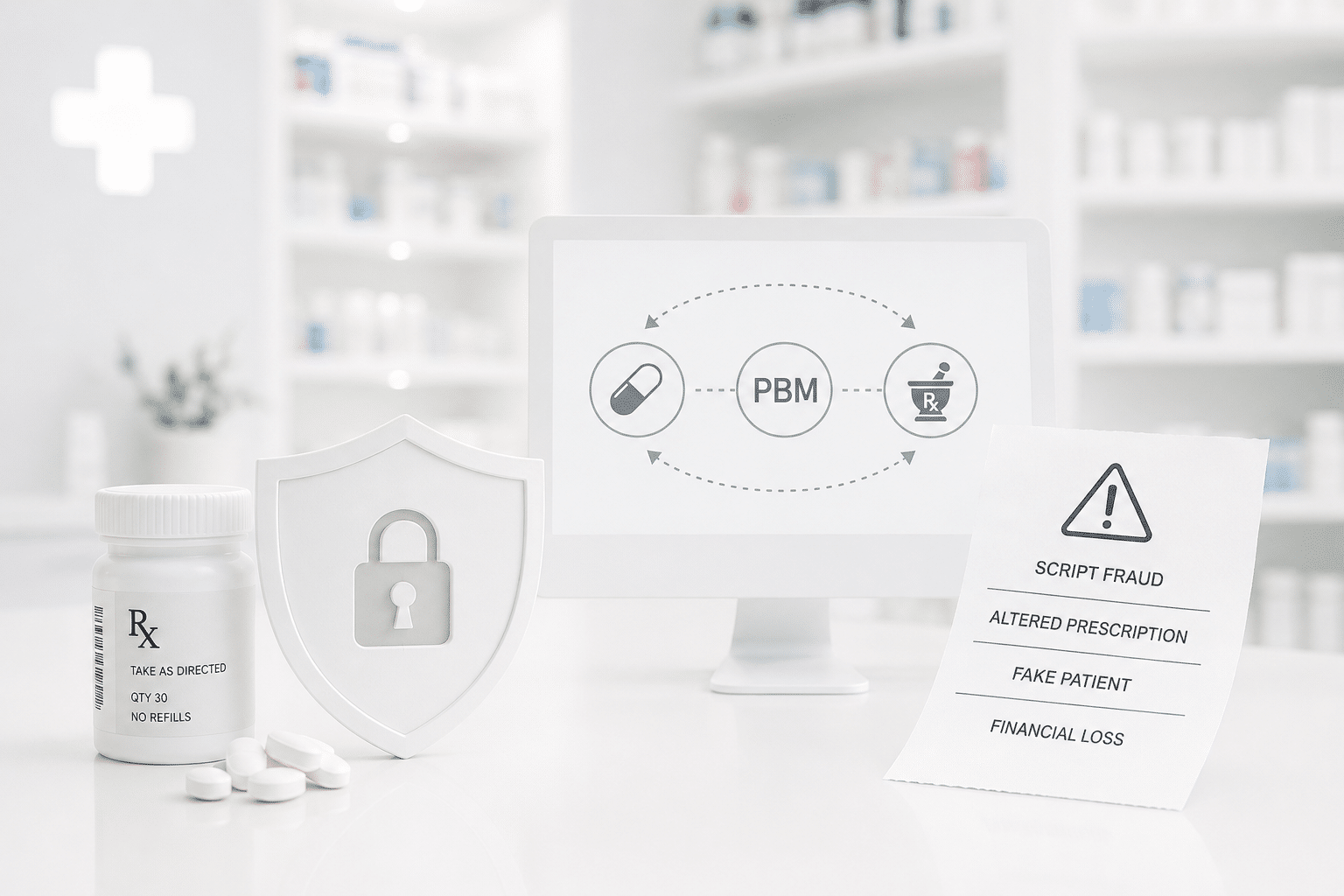
PBM platform integrations. Virtually every pharmacy relies on connections to one or more pharmacy benefit managers to process insurance claims. These integrations create a bidirectional data flow between the pharmacy’s systems and external platforms that the pharmacy doesn’t control. A breach at a PBM can expose pharmacy patient data, and a breach at the pharmacy can potentially affect the PBM connection. Understanding how your cyber policy handles incidents that originate at or affect third-party platforms is important given how central PBM connectivity is to pharmacy operations.
Prescription fraud and diversion. Cybercriminals target pharmacy systems to access prescription records for drug diversion schemes, to manipulate controlled substance records, or to generate fraudulent prescriptions. A breach that enables controlled substance diversion creates not just HIPAA exposure but potential DEA liability and state pharmacy board consequences.
Point-of-sale and payment data. Retail pharmacies process significant payment card volume. PCI DSS compliance is required for any pharmacy that stores, processes, or transmits cardholder data. A breach that exposes payment card data triggers PCI breach notification and assessment obligations in addition to HIPAA requirements.
Ransomware and operational disruption. Pharmacy management systems, dispensing software, and electronic health record connections are all potential ransomware targets. An attack that encrypts dispensing systems can halt prescription fulfillment, creating patient safety concerns in addition to business interruption losses. For pharmacies in hospital systems or health networks, ransomware can cascade across connected systems.
340B program compliance data. Pharmacies participating in the federal 340B drug pricing program maintain records of drug acquisition, dispensing, and patient eligibility that are subject to audit. A breach affecting 340B data or systems creates program compliance exposure on top of HIPAA and operational concerns.
What HIPAA Requires and Where It Falls Short
Pharmacies are covered entities under HIPAA, which means the Security Rule’s requirements for protecting electronic PHI apply in full. Risk analysis, access controls, workforce training, audit controls, and breach response procedures are all required.
What HIPAA does not do is pay for any of these obligations when something goes wrong. A breach affecting pharmacy patients triggers notification to affected individuals, notification to HHS, and in breaches affecting 500 or more individuals in a state, notification to prominent media outlets. HHS Office for Civil Rights investigations can result in corrective action plans and civil money penalties.
The DEA’s Electronic Prescriptions for Controlled Substances regulations add a separate layer of compliance requirements for pharmacies that accept electronic prescriptions. A breach affecting EPCS systems or controlled substance records creates potential DEA regulatory exposure that exists independently of HIPAA.
Cyber insurance responds to the costs of managing these obligations: forensic investigation, legal counsel, patient notification, regulatory defense, and liability claims. It does not replace compliance, but it pays for what compliance alone cannot absorb.
Our post on what HIPAA doesn’t cover and cyber does covers the gap between regulatory compliance and financial protection in more detail.
What Cyber Insurance Covers for Pharmacies
Breach response costs. Forensic investigation to identify what was accessed, legal counsel to navigate HIPAA and state notification requirements, notification to affected patients, and credit monitoring. For a pharmacy with thousands of active patients, these costs scale with the patient population affected.
Regulatory defense. Coverage for the costs of responding to HHS OCR investigations, state attorney general proceedings, and DEA inquiries arising from a cyber incident. Civil money penalties where insurable under applicable law.
Business interruption. Lost revenue and extra expenses when ransomware or a system outage prevents prescription dispensing or normal pharmacy operations. For pharmacies where every hour of downtime is a measurable revenue loss, this coverage is particularly important.
Ransomware and extortion. Ransom demands and the costs of negotiation, decryption, and system restoration. Our post on what ransomware insurance actually covers covers how this coverage is structured.
PCI DSS liability. Coverage for PCI breach notification costs, card replacement assessments, and related liability when payment card data is compromised.
Third-party liability. Claims from patients whose records were exposed, including claims related to the specific harms that prescription record exposure can cause.
Coverage Gaps to Watch For
PBM-originating breaches. If patient data is exposed through a breach at a PBM rather than at the pharmacy’s own systems, how your cyber policy responds to third-party-originating incidents matters. Some policies cover these losses; others treat them differently or exclude them. Confirm how your policy handles vendor-caused breaches before you need it.
DEA regulatory exposure. Not all cyber policies explicitly address regulatory defense for DEA proceedings. If your pharmacy handles controlled substances, confirm that your policy covers regulatory defense costs for DEA inquiries and investigations arising from a cyber incident.
340B audit exposure. A breach affecting 340B program records or compliance documentation may trigger audit obligations with the Health Resources and Services Administration. Whether your policy covers the costs of responding to a 340B audit triggered by a cyber event is worth clarifying at placement.
Prescription fraud liability. If a breach enables fraudulent prescriptions or controlled substance diversion, the downstream liability questions can be complex. Whether your cyber policy, professional liability policy, or neither responds to claims arising from fraud enabled by a breach is worth understanding in advance.
What Underwriters Look For
Pharmacy cyber underwriting follows the standard healthcare framework with a few areas of additional focus.
Multi-factor authentication. MFA on pharmacy management systems, PBM portals, and any remote access is a baseline underwriting expectation. Our post on MFA and cyber insurance covers deployment requirements and documentation.
PBM and vendor access controls. How third-party access to pharmacy systems is controlled and monitored. Underwriters want to see that PBM integrations and other vendor connections are governed with appropriate access controls rather than broad, unmonitored connectivity.
Patch management. Pharmacy management software, point-of-sale systems, and any connected devices need to be kept current. This is particularly important for internet-facing systems and any systems that connect to external platforms.
Backup posture. Regular backups of patient records and dispensing data, stored separately from primary systems and tested for restorability. The ability to restore dispensing operations quickly after a ransomware event directly affects business interruption losses.
PCI DSS compliance. For retail pharmacies processing payment cards, evidence of PCI compliance is an underwriting expectation. Underwriters may ask about your last PCI assessment and any outstanding remediation items.
HIPAA compliance documentation. Current risk analysis, workforce training records, and documented security policies. Underwriters expect to see that HIPAA compliance is active and documented rather than nominal.
Incident response plan. A written plan that addresses pharmacy-specific scenarios, including how prescription fulfillment continuity would be maintained during a system outage and how regulatory notifications would be managed.
For a full picture of underwriting requirements, see The Security Controls Underwriters Check Before They Quote Youand our cyber insurance requirements checklist.
How Pharmacy Cyber Coverage Compares to Other Healthcare Verticals
Pharmacies share the HIPAA framework with other healthcare settings but have a distinct profile in several ways.
Compared to dental practices, pharmacies have a higher volume of more sensitive medication records, significant PBM integration complexity, and point-of-sale payment card exposure that most dental offices don’t have. Our post on cyber insurance for dental practices covers the dental profile.
Compared to behavioral health practices, pharmacies have less psychotherapy note sensitivity but more controlled substance regulatory exposure and higher transaction volume. Our post on cyber insurance for behavioral health practices covers that segment.
Compared to hospitals, pharmacies are typically smaller with fewer internal security resources but face many of the same regulatory obligations. Hospital pharmacy operations within larger health systems take on the security posture of the broader institution. Our post on cyber insurance for hospitals covers the larger healthcare setting.
Frequently Asked Questions
Does a small independent pharmacy need cyber insurance?
Yes. HIPAA notification and regulatory obligations apply regardless of pharmacy size. An independent pharmacy with 2,000 active patients faces the same notification requirements as a chain location after a breach. The costs of forensic investigation, legal counsel, and patient notification can be significant relative to the size of a small operation. Cyber insurance premiums for small pharmacies are modest relative to the exposure.
Does cyber insurance cover DEA regulatory proceedings after a breach?
It can, but this depends on how the policy is written. Regulatory defense coverage in cyber policies often specifies which regulatory bodies are covered. Confirm that DEA proceedings are explicitly included if your pharmacy handles controlled substances and electronic prescriptions.
What happens if a PBM breach exposes my patients’ data?
Your notification obligations to affected patients run to you as the covered entity, not to the PBM. Whether your cyber policy covers the costs of responding to a breach that originated at a PBM depends on how the policy handles third-party-originating incidents. This is a specific question to address when placing coverage.
Do I need separate coverage for PCI liability?
Many standalone cyber policies include PCI-related coverage, including breach notification costs and card replacement assessments. Whether this coverage is adequate for your transaction volume and how it interacts with your payment processor’s requirements is worth reviewing. Some higher-volume pharmacies carry additional payment card liability coverage.
How does cyber insurance interact with my pharmacy’s professional liability coverage?
Professional liability covers errors and omissions in the provision of pharmacy services. A dispensing error is a professional liability event. A ransomware attack that shuts down your dispensing system is a cyber event. A breach that enables a fraudulent prescription may implicate both. Understanding how these coverages coordinate, and whether there are gaps, is part of building a complete program.
Related Resources
- Cyber Coverage for Healthcare: What HIPAA Doesn’t Cover (and Cyber Does)
- Cyber Insurance for Hospitals and Health Systems: Coverage, Risk, and What Underwriters Require
- Cyber Insurance for Dental Offices: Patient Data, HIPAA, and the Coverage Your Practice Actually Needs
- Cyber Insurance for Behavioral Health Practices
- Cyber Insurance and Regulatory Fines: GDPR, CCPA, HIPAA, and What Your Policy Actually Pays
- MFA and Cyber Insurance: What to Deploy, How to Document It, and What Underwriters Require
- Cyber Insurance Requirements: What Underwriters Actually Check
- What Ransomware Insurance Actually Covers
Pharmacies operate at the intersection of healthcare data sensitivity, controlled substance regulation, and high-volume financial transactions in ways that make a generic small business policy inadequate. A cyber program built for healthcare, with specific attention to DEA regulatory exposure, PBM vendor coverage, and PCI liability, is the right starting point.
Ready to review your coverage or get quotes? Contact us or explore your coverage options.